
Most cat-safe plant lists read like a safety pamphlet. They’ll tell you spider plants and Boston ferns are fine, but they don’t tell you how to build a living room that looks like it belongs in an interior design magazine — with a cat in it. This guide does both. Eight plants that are genuinely stunning and fully non-toxic to cats, plus the display solutions that make them look intentional rather than like a compromise.
Affiliate Disclosure: HarvestSense.ai is a participant in the Amazon Services LLC Associates Program. This article contains affiliate links — if you purchase through them, we earn a small commission at no extra cost to you. We only recommend products we’d genuinely use. Full disclosure here.
📋 In This Guide
- The “Safe but Ugly” Problem
- Eight Cat-Safe Plants That Look Expensive
- How You Display Them Matters as Much as What You Grow
- Quick Picks by Budget
- Good, Better, Best: Plant Display Solutions for Cat Households
- Keeping Your Cat Out of the Planter
- Care and Feeding: Making These Plants Thrive Long-Term
- What to Read Next
Affiliate Disclosure: HarvestSense.ai is a participant in the Amazon Services LLC Associates Program. This article contains affiliate links — if you purchase through them, we earn a small commission at no extra cost to you. We only recommend products we’d genuinely use. Full disclosure here.
The “Safe but Ugly” Problem
The standard cat-safe plant advice is well-intentioned but creatively bankrupt. Swap your monsteras for spider plants, they say. Trade the pothos for a peperomia. The subtext is that owning a cat means accepting a certain visual downgrade — that the plants worth having are mostly toxic, and the safe ones are mostly boring.
That’s not accurate, and it’s doing cat owners a disservice. The ASPCA’s non-toxic plant list includes some genuinely spectacular species: calatheas with leaves that look hand-painted, orchids that suggest a level of plant sophistication most people find intimidating, areca palms that fill a corner the way no other plant can. The problem isn’t the plants — it’s that most safe-plant content is written to reassure, not to inspire.
The second gap in most cat-safe plant guides is display. Even a stunning calathea looks like an afterthought sitting on the floor in a basic nursery pot. How you display a plant — the height, the container, the visual hierarchy in a room — determines whether it reads as intentional design or as something you picked up at a hardware store. This guide covers both.
One important clarification before we begin: “non-toxic” on the ASPCA list means the plant won’t cause serious harm if your cat chews on it. It doesn’t mean zero GI upset — any plant matter can cause mild nausea in cats who eat it. The goal is to choose plants where an adventurous chew isn’t an emergency vet visit, while also using display strategies that make the plants less accessible and therefore less tempting. Both approaches together is the right framework.
Eight Cat-Safe Plants That Look Expensive
1. Calathea orbifolia
If there’s one cat-safe plant that genuinely stops people in their tracks, it’s the Calathea orbifolia. The leaves are large — up to 12 inches across on a mature plant — with bold silver-green stripes that look almost airbrushed. It’s the plant people assume is fake when they see it in a well-designed room. Calathea orbifolia prefers bright indirect light and consistent moisture without soggy soil, and it does not like cold drafts or direct sun. It’s fussier than most plants on this list, but the payoff is proportional. Other calathea varieties worth considering: Calathea medallion (rounder, purple undersides), Calathea lancifolia (rattlesnake plant, architectural and striking), and Calathea ornata (pinstripe markings).
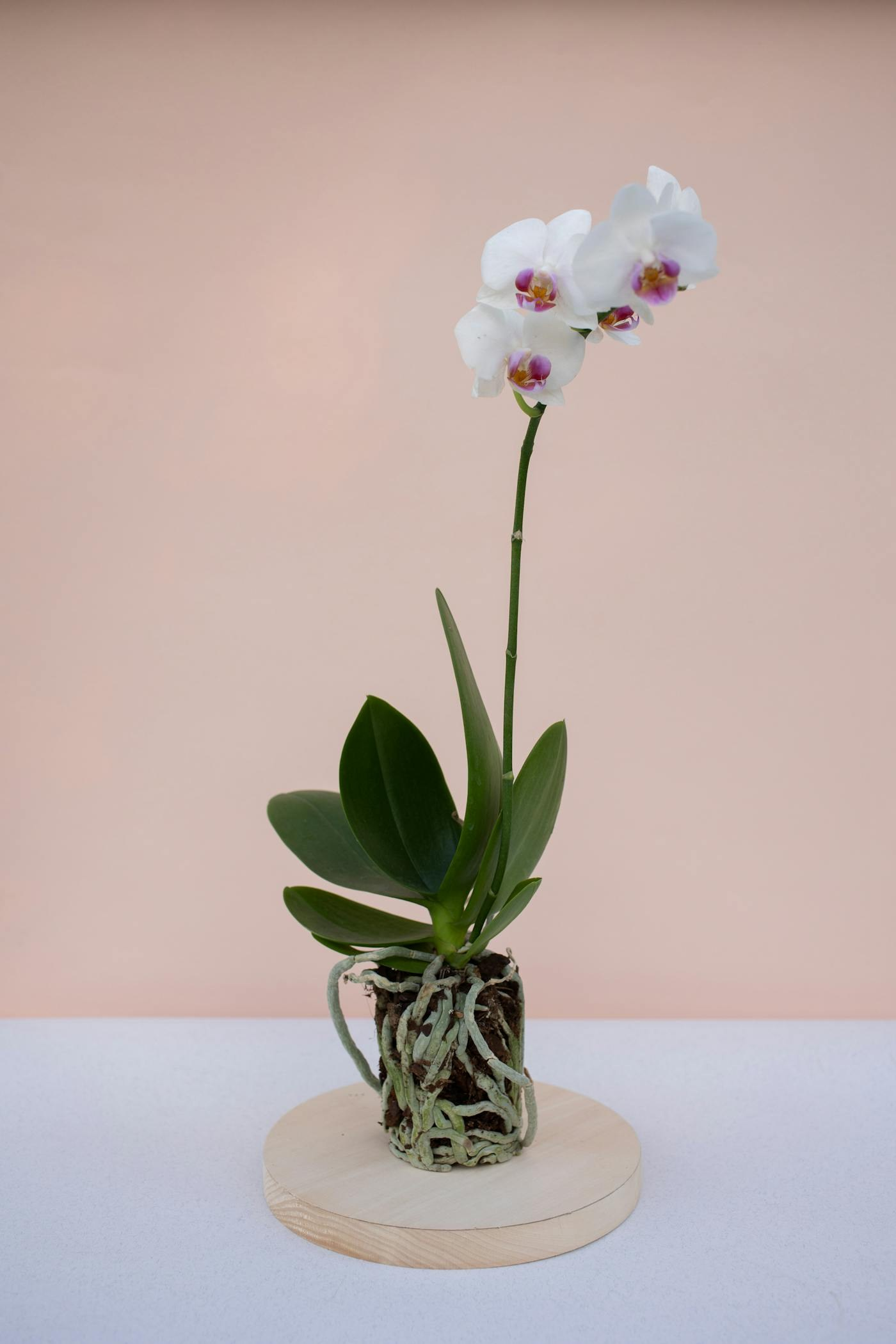
2. Phalaenopsis orchid
Orchids have a reputation for being difficult that they’ve never quite deserved. Phalaenopsis — the moth orchid, the one you see in every florist and home goods store — is one of the most forgiving houseplants you can own once you understand its two rules: bright indirect light and infrequent watering (once a week at most, letting the roots dry almost completely between waterings). They’re fully cat-safe, and a blooming phalaenopsis in a clean white or terracotta pot reads as significantly more expensive than it is. A single $20 grocery store orchid, repotted into a proper ceramic planter and placed at the right height, can anchor an entire room.
3. Areca palm
For sheer volume and visual impact, nothing in the cat-safe plant world competes with the areca palm (Dypsis lutescens). A mature specimen in a large floor planter fills a corner in a way that reads as resort-level tropical — the kind of plant that shows up in hotel lobbies and interior design shoots. It’s non-toxic to cats and dogs, tolerates medium to bright indirect light, and grows reliably given regular watering and the occasional dose of liquid fertilizer during the growing season. The main investment is patience: areca palms grow slowly. Buy the largest one you can justify at the outset.
4. Boston fern
Boston ferns are one of those plants that look significantly better elevated than they do at floor level. The arching, feathery fronds read as lush and Victorian-elegant when hung or placed on a tall stand where they can cascade downward — at floor level, the same plant looks like it needs watering. Boston ferns want humidity, consistent moisture, and bright indirect light. They’re a natural fit for bathrooms with windows or kitchens near a sink. Fully cat-safe.
5. Peperomia obtusifolia (baby rubber plant)
Peperomia obtusifolia doesn’t get enough credit. The leaves are thick, dark, and glossy in a way that reads as succulent-adjacent, and the plant holds its shape without constant maintenance — it’s nearly impossible to kill with neglect. Bright indirect light is ideal, but it tolerates lower light better than most plants on this list. At 12–15 inches tall at maturity, it’s a desk or shelf plant, not a floor plant, which makes container choice and placement particularly important. There are also variegated forms (cream and green) that push the “expensive-looking” quality further.
6. African violet
African violets are one of the most underrated plants in the cat-safe category. When they’re blooming — which, with the right conditions, is almost year-round — the jewel-toned flowers against velvety dark leaves create a look that’s frankly hard to replicate with more fashionable plants. They prefer bright indirect light and bottom watering (top watering causes leaf spotting), and they bloom most reliably when slightly pot-bound. Place them in a small, elevated ceramic planter with good drainage and they look like they came from a specialty florist.
7. Spider plant
The spider plant (Chlorophytum comosum) gets written off as a basic choice, which is unfair to what it actually does well: it cascades beautifully from height. A spider plant in a macramé hanger or on a tall stand, with long runners and baby plantlets hanging down, is genuinely architectural — the same plant on a windowsill is forgettable. The variegated form (green with a white center stripe) is more visually refined than the solid green. Extremely forgiving, tolerates low light, fast-growing. The aesthetic potential here is almost entirely about the display strategy.
8. Bromeliad (Guzmania or Vriesea)
Bromeliads deliver a pop of architectural color — the bright central rosette in red, orange, yellow, or pink — that looks like it cost significantly more than it did. They’re epiphytes in the wild, which means they don’t need much soil and do well in small, decorative containers. They require very little care: water the central cup (the rosette), give them bright indirect light, and they’ll hold their display for months. The Guzmania lingulata and Vriesea splendens are the most widely available and most visually striking. Fully non-toxic to cats.
How You Display Them Matters as Much as What You Grow
Display is the variable most plant guides skip over, and it’s where the difference between a room that looks designed and a room that looks like it has some plants lives. A few principles worth internalizing:
Elevation changes everything
Plants at floor level have to work much harder to make a visual impact than plants at eye or chest level. A calathea orbifolia on a tall stand commands a room; the same plant on the floor competes with baseboards and furniture legs. Elevation also solves a practical problem in cat households: the higher the plant, the less likely it is to be investigated, chewed, or knocked over. Cats are less motivated to jump to a surface that has no obvious stepping-stone path up to it, and a tall single-post stand with no shelves below it is genuinely difficult for most cats to access.
Vertical groupings read as intentional
A single plant on a single stand looks like a plant. Three plants on a tiered display — varied heights, varied textures, in coordinating containers — looks like a deliberate design choice. A five-tier plant stand in a corner creates a vertical garden effect that fills space without requiring floor area, and the height of the top tier puts those plants well out of cat reach. This approach also lets you mix plant types strategically: trailing spider plants on the higher tiers where the cascading effect is best, compact peperomias and African violets on the lower tiers where their shorter form works.
Container choice anchors the whole look
The nursery plastic pot a plant comes in is almost never the right permanent container. A calathea in a white ceramic pot on a walnut-finish stand looks like a design object. The same calathea in a black plastic nursery pot on the floor looks like you haven’t unpacked yet. Ceramic, terracotta, and high-quality resin containers all work — the key is that the container material, color, and size are chosen intentionally to complement the plant rather than just contain it.
⚡ Quick Picks by Budget
- 🟢 Good — Fox & Fern Adjustable Tall Plant Stand (~$35)
Bamboo mid-century stand with adjustable width — fits 8 to 12 inch pots, two height settings, clean single-post design that deters cat climbing. - 🔵 Better — GEEBOBO 5-Tier Plant Stand (~$41)
Corner display shelf for multiple plants at staggered heights — the multi-plant vertical garden approach. - ⭐ Best — BACEKOLL 62″ S-Shaped Stand with Grow Lights (~$90)
Tall statement stand with built-in full-spectrum grow lights — solves the light problem and the elevation problem simultaneously.
Good, Better, Best: Plant Display Solutions for Cat Households
🟢 Good — Fox & Fern Adjustable Tall Plant Stand (~$35)
The Fox & Fern Adjustable Tall Plant Stand brings a clean bamboo mid-century modern aesthetic with a practical twist: adjustable width fits pots from 8 to 12 inches, so it works for a compact orchid today and a larger calathea down the road. Two height settings let you fine-tune the elevation for your space. The single-post design — no shelves below — gives cats no obvious stepping-stone path up to the plant, making it one of the more naturally cat-resistant display formats available. A well-made, versatile choice that complements a wide range of interior styles.
🔵 Better — GEEBOBO 5-Tier Plant Stand (~$41)
Five staggered tiers in pine wood, in a triangular corner footprint that fits neatly into a room corner without taking up significant floor area. The GEEBOBO holds multiple plants at varied heights, which is the display approach that reads most clearly as intentional design — spider plants trailing from the top tier, compact peperomias and African violets filling in the middle, a bromeliad anchoring the bottom. The top tier sits high enough (34 inches at the apex) that plants placed there are out of easy cat reach. Solid construction with a stable triangular base.
⭐ Best — BACEKOLL 62″ S-Shaped Stand with Grow Lights (~$90)
A 62-inch tall, 8-tier S-curved stand with three built-in full-spectrum LED grow light heads — and this combination solves two problems at once. The height puts the top tiers genuinely out of cat reach, and the built-in lights mean you’re not constrained by window placement. You can put this in a dim corner of a living room or bedroom and maintain calatheas, ferns, and orchids with no natural light compromise. The grow lights have 10 brightness levels and a timer function, which is important: calatheas and ferns need consistent photoperiods to stay healthy, and a timer removes that variable entirely. The S-curve form is a visual statement in itself — this is a piece of furniture as much as it is a plant stand.

Keeping Your Cat Out of the Planter
Elevation handles a lot, but some cats are determined and athletic. If your cat has figured out how to access your plants despite the height, a few additional approaches are worth adding to the strategy.
Bitter deterrent spray
The most direct intervention is a bitter taste deterrent applied to the leaves. Grannick’s Bitter Apple spray (~$12) is the category standard — it’s non-toxic, dries clear, and produces a taste response that most cats learn to associate with that plant within a few exposures. Apply it to the leaves (not the soil) every few days initially, then as needed once the behavior has changed. It’s not a permanent solution on its own, but as a training tool used alongside elevation, it’s effective for most cats.
Physical soil barriers
Cats that are interested in digging in soil rather than chewing leaves need a different intervention. A layer of decorative stones, pine cones, or aluminum foil placed on top of the soil surface makes the digging behavior unrewarding. Decorative river stones are the most aesthetically integrated option — they read as part of the display rather than a deterrent, and they also help retain moisture in the pot.
Strategic plant placement
Think about your cat’s movement patterns in each room. Cats typically don’t jump to surfaces they can’t see a landing path to — a plant on a stand in the middle of a room with no adjacent furniture is far less attractive than a plant on a windowsill with a chair nearby. Removing the stepping stones (literally) is often enough. If there’s a specific shelf or table where your cat keeps going for a plant, relocating the plant to a stand in a different part of the room that doesn’t have nearby jump-to furniture often resolves the issue without any additional deterrents.
Care and Feeding: Making These Plants Thrive Long-Term
Eight different plants have eight different care profiles, but there are a few principles that apply broadly to all of them and that determine whether an indoor plant looks lush and intentional or struggling and neglected.
Soil quality matters more than watering frequency
Most houseplant failures come down to one of two things: too much water or soil that doesn’t drain well enough. These two problems compound each other — poor-draining soil stays wet longer, which causes root rot even when watering frequency is correct. A quality potting mix with good drainage prevents this. FoxFarm Happy Frog (~$20) is a pre-amended all-purpose potting mix that works for all the plants on this list — it has good drainage, appropriate pH, and beneficial microbes that support root development. Avoid generic potting soils that compact over time and hold water poorly.
Fertilizing on a schedule
Most potting mixes contain enough nutrients for 2–3 months after repotting, after which plants need supplemental fertilization to maintain vigorous growth. An organic liquid fertilizer applied every 2–3 weeks during the active growing season (spring through early fall) keeps foliage dense and healthy. Neptune’s Harvest fish and seaweed fertilizer (~$18) is a good all-purpose organic option that works for all the plants on this list. Dilute it to half strength for sensitive plants like calathea and African violet — these two are more prone to fertilizer burn than the rest.
Humidity for the fussier plants
Calathea, Boston fern, and orchids all prefer higher humidity than most apartments provide, especially in winter when heating systems dry the air significantly. A simple pebble tray filled with water placed under the pot creates a local humidity zone through evaporation — no humidifier required. Grouping these plants together also helps, since transpiration from multiple plants raises local humidity. If your calathea is browning at the leaf tips despite correct watering, low humidity is almost certainly the cause.
When to repot
Most of the plants on this list benefit from repotting every 1–2 years into a container one size larger (2 inches in diameter). The exception is African violets, which actually bloom more prolifically when slightly pot-bound — repot them only when roots are visibly circling the bottom of the pot. Signs that any plant needs repotting: roots growing out of drainage holes, water running straight through the pot without absorbing, or growth slowing significantly despite good light and regular fertilizing.
What to Read Next
This guide covers the plant and display side of the cat-safe indoor garden equation. For the full context on building a pet-safe indoor garden from the ground up:
- The 2026 Pet-Safe Indoor Garden Guide — the hub article covering plant safety, zone design, and the full framework
- Keeping Dogs Out of Your Container Garden: The 2026 Guide to Pet-Proof Planting
And if display and container choice has you thinking about the broader indoor garden design question:
- Beautiful and Functional Small-Space Indoor Garden Design — layout, vertical space, and making a small-space garden look intentional
- Fiberglass vs. Terracotta Planters: Which Is Right for Your Space? — a deep-dive on container materials and aesthetics
Questions about a specific plant or setup? Send us a note — we read every one.