
Disclosure: This article contains affiliate links. If you purchase through them, HarvestSense.ai earns a small commission at no extra cost to you. I only recommend products I’ve researched thoroughly. Full disclosure policy here.
📋 In This Guide
- Step 1: Know Your Space Before You Buy Anything
- The Beautiful + Functional Framework
- Choosing Plants for Visual Impact and Real Use
- Container Strategies: Aesthetic, Functional, and Both
- Vertical Space: The Small-Space Gardener’s Secret Weapon
- Soil and Growing Media That Actually Work Indoors
- Self-Watering Solutions for Busy Tiny-Space Livers
- Solving the Light Problem in Any Small Space
- Three Complete Small-Space Garden Setups
- Where to Go from Here
You didn’t downsize your living space to settle for a sterile, bare interior. Whether you’re in a 400-square-foot apartment, a park-model RV, a loft condo, or a converted tiny home, you already know the truth about small-space living: every design decision carries weight. A single plant in the wrong pot can look cluttered. The right arrangement of three plants on a tiered stand can make a room feel alive.
This guide is about building an indoor garden that does both jobs — one that looks intentional and beautiful, and one that actually functions: herbs you can cook with, plants that clean your air, greenery that thrives rather than slowly dies on a neglected windowsill. The good news is that small spaces are actually easier to design well than large ones. Constraints force creativity, and creativity is what makes a tiny-space garden look curated rather than cobbled together.
Step 1: Know Your Space Before You Buy Anything
The single most common mistake small-space gardeners make is buying plants and pots before understanding their environment. A pothos that would trail beautifully on a shelf dies in six weeks because the shelf is two feet from a north-facing window. A cast-iron planter that looks stunning on a balcony cracks the floor joists because nobody checked the weight rating first.
Before you spend a dollar, answer four questions:
How much light do you actually get? Stand in your space at noon and look at your shadows. Sharp, defined shadows mean direct or near-direct light — you can grow almost anything. Soft shadows mean bright indirect light — still excellent for most herbs and tropical plants. No shadows at all means low light — you’re limited to shade-tolerant species unless you add a grow light. If you live in an RV, your light exposure changes as you move; plan for the lowest-light scenario.
What’s your humidity situation? RVs and tiny homes with propane heat tend to be drier than apartments. Condos with HVAC run dry in winter. This matters because tropical plants like monsteras and peace lilies struggle in low humidity, while succulents and snake plants thrive in it. Match your plants to your actual conditions rather than forcing expensive solutions.
What surfaces can you actually use? A window ledge that gets direct afternoon sun is prime real estate for herbs. A north-facing wall with no natural light is still usable — with the right wall planter and a small grow light. A corner with no floor space at all can hold a tiered stand if the ceiling is clear. Map your surfaces before you start spending.
What’s your weight limit? This is non-negotiable in RVs, manufactured homes, and balconies. A large ceramic planter filled with wet soil can easily reach 30–40 pounds. Lightweight alternatives — fabric containers, fiberglass, or resin planters — let you keep the aesthetic without the structural risk. We cover balcony weight limits in depth in our Apartment Balcony Weight Limits guide.
The Beautiful + Functional Framework
Good small-space garden design follows three principles that apply equally to a 28-foot Class A motorhome and a 600-square-foot studio apartment.
Think in layers, not clusters. The temptation in small spaces is to group all your plants together on a single surface. This looks cluttered fast. Instead, think vertically: one focal plant at eye level, something at medium height on a tiered stand, and something low on the floor or a side table. Three plants spread intentionally across three heights reads as designed. Ten plants crammed on one shelf reads as chaos.
Choose a container palette and stick to it. Pick two or three pot materials — say, white ceramic and natural terracotta — and buy only those. Mixed materials in mismatched colors is the fastest way to make a carefully chosen plant collection look like a garage sale. The plants themselves provide color variety. Your containers provide visual cohesion.
Function earns its place. In a small space, every item must justify its square footage. A plant that looks beautiful but requires daily misting, fussy watering, and bright direct sun earns its spot only if you can realistically provide that. A trailing pothos in a ceramic wall planter that you water once a week and largely ignore is a more honest choice for most small-space livers. This isn’t settling — it’s designing with reality.
Choosing Plants for Visual Impact and Real Use
The best small-space plants do at least two things: they look good, and they do something useful. Here are the categories worth prioritizing.
Trailing plants
Trailing plants are the most valuable category for small spaces because they use vertical space without requiring floor space. A pothos, heartleaf philodendron, or string of pearls on a high shelf or in a wall planter creates a dramatic visual effect with almost zero care. Pothos in particular thrives in low to medium light and tolerates inconsistent watering — exactly what most busy small-space livers need.
Compact edibles
Compact edibles are where functional and beautiful intersect. Herbs — basil, thyme, rosemary, chives — grow beautifully in small ceramic pots on a windowsill, and you actually use them. A Bamworld 3-tier ladder stand holding six small herb pots near a sunny window is one of the most visually satisfying small-space garden setups you can build — and it feeds you. Compact dwarf varieties of peppers, cherry tomatoes, and even strawberries can work on a sunny south-facing windowsill or with supplemental grow light support.
Want to take compact edibles a step further? Growing dwarf fruiting trees — Meyer lemons, compact citrus, dwarf olive — adds year-round visual drama while producing real fruit in a container no larger than 15 gallons. We cover this in depth in our full guide: Growing Dwarf Meyer Lemons Indoors: Container Guide for Apartment Growers — container selection, citrus-specific soil, fertilizer for fruit, and the hand-pollination step most indoor growers miss.
Statement plants
Statement plants serve as focal points and anchor the visual design. A compact snake plant (Sansevieria) or ZZ plant brings strong sculptural lines, tolerates near-neglect, and thrives in low humidity — making both ideal for RVs. A peace lily provides lush tropical texture and occasional white blooms in medium indirect light. A Bambino fiddle-leaf fig tops out around three feet tall, giving you the visual drama of a tree-scale plant without overwhelming a small room.
Air plants
Air plants (Tillandsia) deserve special mention for tiny spaces because they need no soil, no pot, and minimal water — just a misting every week or two and some indirect light. They can sit in small geometric holders on a shelf, mounted on driftwood, or displayed in hanging glass terrariums. The zero-maintenance footprint makes them perfect for RV dwellers who spend time away from their plants.
Container Strategies: Aesthetic, Functional, and Both
Your container choices do more work in a small space than in a large one. Here’s how to think through the tradeoffs.
Ceramic planters
Ceramic planters are the gold standard for aesthetics. The glaze options are endless, they retain moisture well, and a well-chosen ceramic pot elevates a basic pothos into a design statement. The tradeoffs: they’re heavier than plastic alternatives, and they can crack in freezing temperatures — relevant for RV owners in cold climates.
Self-watering planters
Self-watering planters are the practical upgrade that make a small-space garden actually sustainable. The sub-irrigation approach — where water sits in a reservoir below the soil and wicks upward as needed — eliminates the most common cause of indoor plant death (inconsistent watering) without adding any effort. For a more premium aesthetic, the Lechuza Puro 20 self-watering planter (~$40) brings the same German engineering we love in the Lechuza BALCONERA — a matte finish, visible water indicator, and sub-irrigation system in a compact round profile that works beautifully on a shelf or side table.
Wall-mounted planters
Wall-mounted planters are the small-space secret that most people overlook. Vertical wall space is often completely unused — and a set of ceramic wall pockets turns a blank wall into a living gallery without occupying any floor or shelf space. The MKONO 3-tier hanging wall planter set (~$22) holds three small pots in a stacked vertical arrangement and installs with just two screws. It’s the quickest high-visual-impact upgrade available for under $25. Trailing pothos, small succulents, and air plants all work beautifully in wall-mounted configurations.
Hanging planters
Hanging planters do the same job from above. A ceiling hook over a window and a macramé or ceramic hanging planter creates a cascading display that uses space nobody else is competing for. The LA Jolie Muse Hanging Planters for Indoor Plants (~$28) pairs a clean ceramic bowl with a sturdy rope hanger — perfect for Boston ferns, trailing pothos, or spider plants near a window. The open design looks handcrafted without the complexity.
Choosing the right container material matters most when balcony or RV weight is a constraint. Fiberglass and resin planters can match the aesthetic of ceramic at a fraction of the weight. We cover the full comparison in our dedicated guide: Fiberglass vs. Terracotta Planters: The Weight-Rated Container Guide for Small Spaces (2026) — real weight numbers, when each material wins, and Good/Better/Best picks.

Vertical Space: The Small-Space Gardener’s Secret Weapon
If there’s one organizing principle that separates thriving small-space gardens from crowded ones, it’s the intentional use of vertical space. Floor and counter space is finite and expensive. Vertical space is almost always underused.
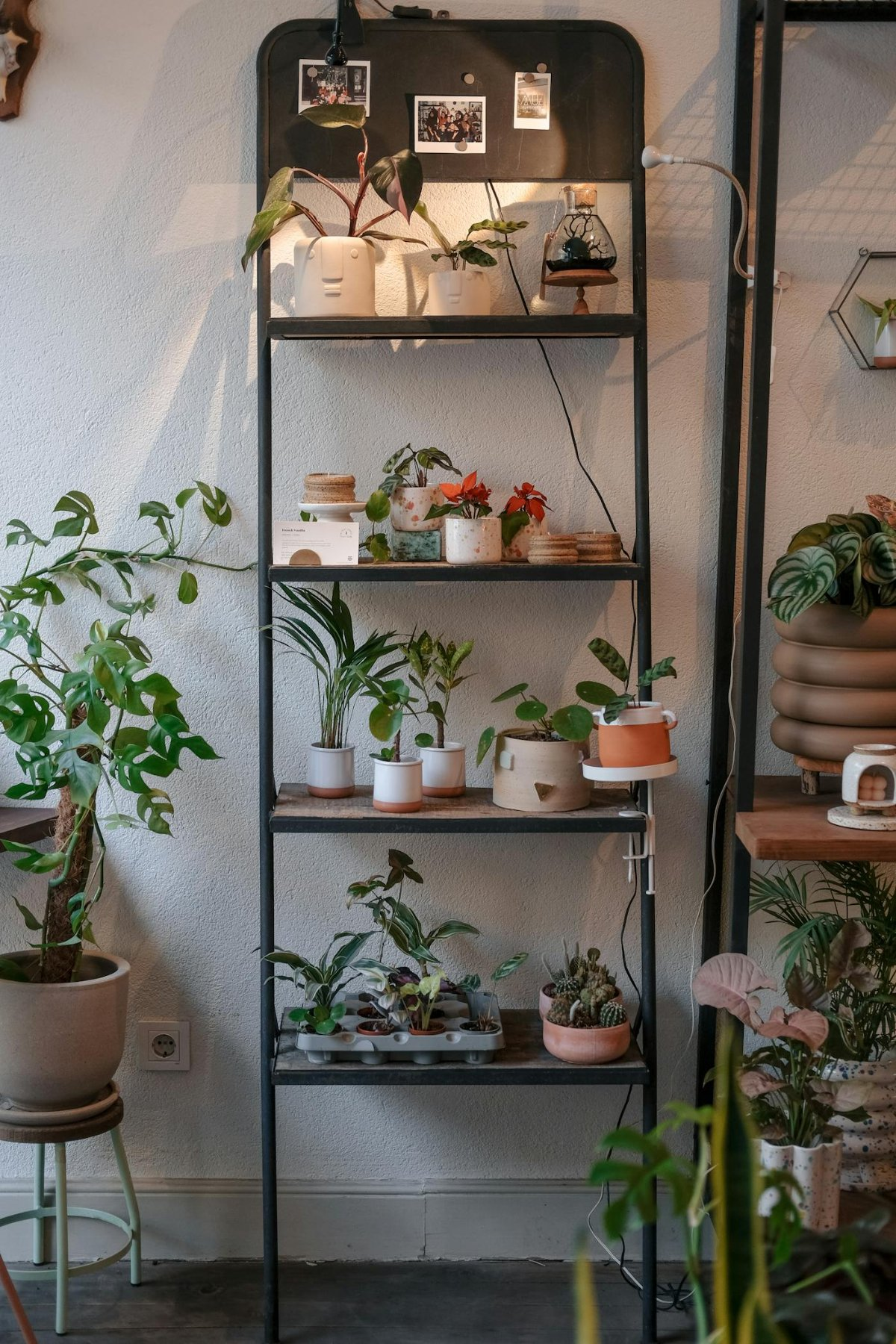
The most versatile vertical tool for indoor gardens is a tiered ladder plant stand. A well-chosen stand creates a display structure that makes six to eight plants look like a curated installation rather than a collection of mismatched pots. The Bamworld 3-tier ladder stand (~$35) fits the width of a standard windowsill, holds seven pots across three levels, and the warm bamboo-and-metal construction works with everything from modern minimalist to boho interiors. Position trailing plants on the top tier so they cascade downward — this adds visual depth and makes the entire arrangement feel intentional.
For tighter spaces — RV slideouts, narrow apartment corners — wall-mounted shelves are a better fit than floor-standing racks. A single floating shelf at eye level with three plants in a coordinating container palette costs almost nothing in floor space and creates immediate visual impact. The key is bracket quality: use proper wall anchors and check that your mounting surface can handle the wet weight of your pots. For RVs specifically, hit actual studs or use specialized RV mounting hardware — most RV walls are thin paneling over aluminum framing.
Grow light tip: A small clip-on or shelf-integrated grow light means you’re no longer limited to windowsill proximity — any wall or corner location becomes viable regardless of natural light. See our Best Grow Lights for Apartments guide for specific product picks across Good/Better/Best tiers.
Soil and Growing Media That Actually Work Indoors
Outdoor potting soil in an indoor container is one of the most common and least obvious causes of indoor plant failure. Outdoor mixes are designed for large containers with excellent drainage — in a small indoor pot, the same mix can compact, become waterlogged, and suffocate roots within a season.
For most indoor container plants, you want a mix that is lightweight (critical for RVs and weight-sensitive balconies), well-aerated (prevents root rot), and nutritionally balanced. FoxFarm Happy Frog potting mix (~$16 for 12qt) is the most consistent performer we’ve found for indoor containers — pre-amended with mycorrhizae and humic acids, pH-adjusted for optimal nutrient uptake, and light enough that a filled 8-inch pot won’t strain a floating shelf. For succulents, cacti, and drainage-focused plants, cut your potting mix 50/50 with perlite.
For self-watering planters used with LECA (lightweight expanded clay aggregate), soil isn’t required at all. LECA provides structural support for roots while keeping water available through capillary action. It’s reusable, essentially weightless, and eliminates fungus gnats entirely — since gnats require organic soil to breed. If you’re pairing self-watering planters with a clean, low-maintenance aesthetic, LECA is worth considering.
Self-Watering Solutions for Busy Tiny-Space Livers
The biggest obstacle to a successful indoor garden isn’t light, soil, or even plant selection — it’s consistent watering. Overwatering kills more indoor plants than underwatering. Hand-watering on a schedule sounds manageable until life gets busy, you spend a weekend away from the RV, or you simply forget for ten days.
Self-watering planters solve this at the container level. The sub-irrigation reservoir means you fill it every one to three weeks, and the plant takes what it needs. No overwatering, no underwatering, and no guilt when you come back from a trip. For a full comparison of vacation-proof watering systems — including terracotta spikes, automatic drip systems, and WiFi-connected moisture sensor setups — see our Vacation Care for Indoor Gardens guide.
For plants in non-self-watering containers, a simple moisture meter (available for under $15 on Amazon) eliminates the guesswork entirely. Push it into the soil; if it reads dry, water. If it reads moist, leave it alone. It’s the single cheapest tool that meaningfully improves plant survival rates for new indoor gardeners.
Solving the Light Problem in Any Small Space
Natural light is the most common constraint in small-space gardening, and it’s the one most people give up on prematurely. A north-facing apartment, a windowless RV slide, or a condo unit shadowed by an adjacent building feels like a dead end — but it isn’t.
The first step is choosing plants that genuinely thrive in low light rather than plants that merely survive in it. Snake plants, pothos, ZZ plants, peace lilies, and cast-iron plants all perform well in indirect or low-light conditions. Herbs — which need six or more hours of light daily — are not a good fit for low-light spaces without supplemental lighting.
The second step, for anyone who wants to grow herbs or edibles in a low-light space, is a full-spectrum LED grow light. Modern options are compact, energy-efficient, and available in profiles that don’t look industrial. Discreet shelf-mounted bars and clip-on options blend into a plant display without making it look like a grow operation. See our Best Grow Lights guide for a full breakdown from $32 to $299. For a deep dive on light science in small spaces — including UV-filtered window glass and photon efficiency — our High-Rise Food Security guide covers the full picture.
Three Complete Small-Space Garden Setups
Rather than abstract principles, here are three specific setups that work for real small-space constraints.
The RV Window Setup (~$85 total)
A south-facing RV window is prime real estate. Position a 3-tier ladder stand ($35) next to the window with six small ceramic pots in a consistent color palette: two herb pots (basil, thyme) on the top tier closest to the light, two trailing pothos on the middle tier, and two succulents at the base. Add a Lechuza Puro 20 self-watering planter ($40) on the counter for a statement snake plant or ZZ plant. Total weight fully planted: under 15 pounds. Total visual impact: significant.
The Studio Apartment Wall Garden (~$65 total)
For apartments with no balcony and minimal floor space, the wall is your primary canvas. Mount the MKONO 3-tier wall planter ($22) on a well-lit wall — three small pots in a vertical stack, planted with trailing pothos, a small succulent, and a compact herb. Add the LA Jolie Muse hanging planter ($28) from a ceiling hook near the window with a heartleaf philodendron. Use FoxFarm Happy Frog mix ($16) for all potted plants. This setup uses zero floor space and creates immediate visual warmth on an otherwise bare wall.
The Condo Balcony Display (~$150 total)
A condo balcony — even a narrow Juliet balcony — can support a full display garden when you think vertically and weight-consciously. A 3-tier ladder stand ($35) against the balcony wall holds herbs, trailing plants, and compact flowering annuals. Two Lechuza Puro 20 self-watering planters (~$80 for two) hold a compact herb collection and trailing ornamental vines. The sub-irrigation reservoir means you water once every one to two weeks rather than daily. Total display weight fully watered: under 25 pounds. See our balcony weight guide for how to calculate your specific load.
Where to Go from Here
This guide gives you the framework — space assessment, design principles, plant selection, container strategies, vertical display, soil, watering, and light. The next step is going deeper on the specific elements that match your space and goals.
If growing your own food is a priority, our High-Rise Food Security master guide covers the full picture of small-space food production, from hydroponic towers to balcony container gardens. For a deep dive into hydroponic systems specifically, Vertical Hydroponic Towers for Apartments walks through the Good/Better/Best options at every price point.
The articles below go deeper on the specific decisions you’ll face as you build out your setup:
- Vertical Hydroponic Towers for Apartments: A Hands-On Comparison — Good/Better/Best hydroponic systems for any budget
- Best Grow Lights for Apartments (2026) — honest picks from $32 to $299
- Apartment Balcony Weight Limits: Your Safe Container Garden Guide — how to calculate your load and choose featherlight containers
- Vacation Planning for Indoor Growers — Good/Better/Best solutions for keeping every plant alive while you’re away
- Fiberglass vs. Terracotta Planters: The Weight-Rated Container Guide for Small Spaces (2026) — real weight numbers, honest trade-offs, and Good/Better/Best container picks for balconies and small spaces
- Growing Dwarf Meyer Lemons Indoors: Container Guide for Apartment Growers — Good/Better/Best container, soil, and fertilizer picks, plus the hand-pollination step that actually gets you lemons
Small spaces don’t require small ambitions. They require smarter choices — and now you know how to make them.
Have a question about your specific setup? Use the contact form — I read every message and try to respond to every genuine question about small-space gardening.